Takeshima
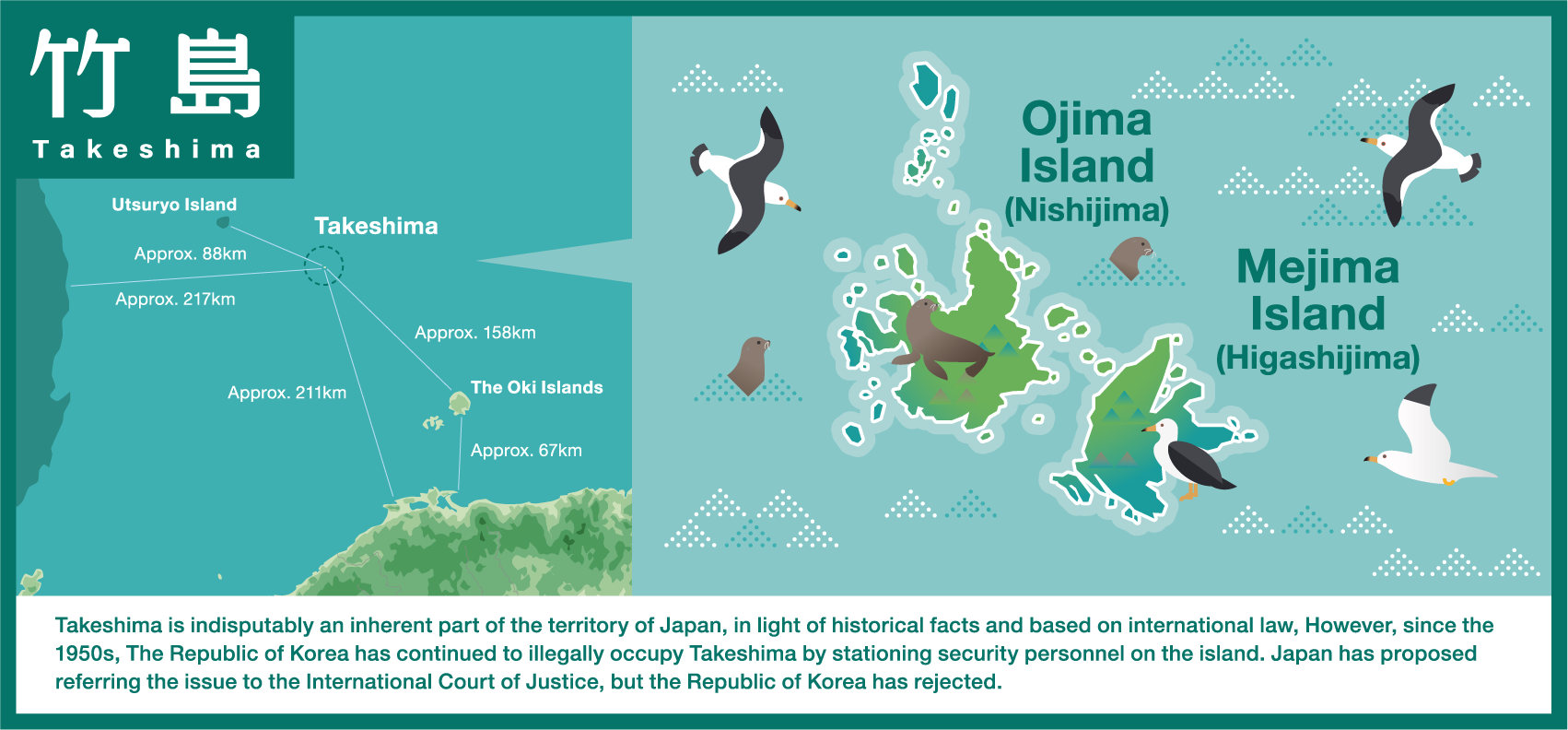
Using videos, panels, exhibits, etc., visitors can learn basic information on the geography, history, and current situation of Takeshima.
Videos
Basics
Takeshima
In the 17th century, merchants in Yonago traveled to Takeshima to conduct business with the permission of the Edo Shogunate.
Oya Jinkichi and Murakawa Ichibee, merchants from Yonago who operated a shipping business, made a request to the Edo Shogunate for passage to Utsuryo Island, an uninhabited island abundant in lumber and marine products. With the Shogunate’s permission, the families of Oya and Murakawa took turns travelling to Utsuryo Island each year and carried out their business. Takeshima, on the route from Oki to Utsuryo Island, came to be used as a navigational marker, a place to moor their ships and a rich fishing ground for sea lions and abalone. Takeshima was used under the permission of the Shogunate, as is recorded in the “Kameyama Letter” on display and in the following documents.
Record of what I (Oya Kyuemon Katsunobu) said when a Shogunate inspector lodged at the Oya family residence in the 9th year of Enpou (1681)
This is a record of Kyuemon-Katsunobu’s reply to the inquiries by the Shogunate inspector who lodged at the Oya family residence in May 1681 (the 9th year of Enpou era). According to this record, Takeshima was bestowed to the Oya family 24 or 25 years ago in the reign of Shogun Tokugawa Ietsuna, and the family caught sea lions there. The contents of this record match the contents of “A letter from Kameyama Shozaemon to Oya Kyuemon Katsuzane" in the display case.
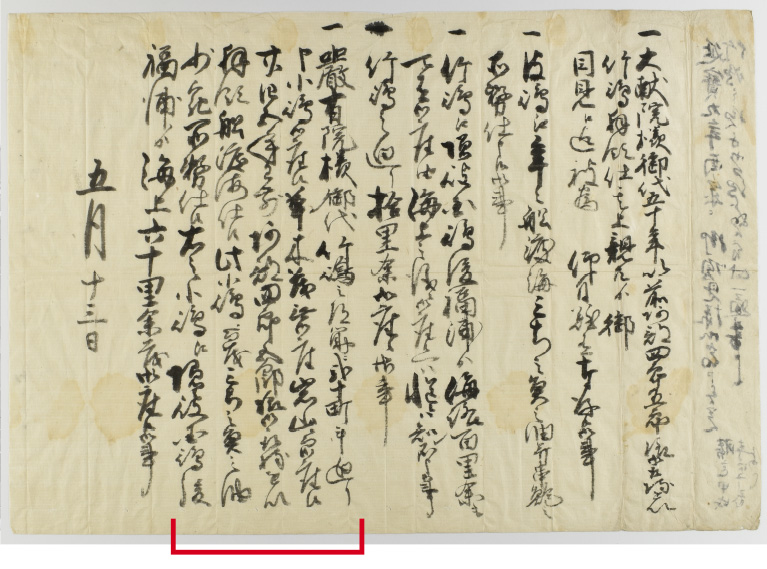
The picture is a copy made by Oya Shinkuro-Katsuoki in 1810 (Bunka 11)
[Repository] Shimane Prefecture Takeshima Reference Room
Excerpt (Provisional Translation)
There is a small island en route to Takeshima (current Utsuryo Island) that has a circumference of approximately 20 cho (2.2 km) and is rocky without vegetation. During the reign of Lord Gen-yu-in (i.e. the fourth Tokugawa Shogun, Ietsuna), this island was bestowed to us 24 or 25 years ago through the brokerage of Shiro-Goro Abe. We sail to the island and catch sea lions there for oil.
The Japanese Government incorporated Takeshima into Shimane Prefecture in 1905 and openly and continuously exercised administrative rights over Takeshima.
Around 1900, sea lion hunting became active around Takeshima and soon excessive
competition became a concern. To stabilize the sea lion hunting business, Nakai Yozaburo, a resident of
the Oki Islands in Shimane Prefecture, submitted a request in 1904 to lease Takeshima. Upon the request
from Nakai, the Japanese Government incorporated Takeshima into Shimane Prefecture by a Cabinet decision
in January 1905.
Thereafter, the Japanese Government, including Shimane Prefecture, openly and continuously exercised
administrative rights over Takeshima for the purpose of regulating and taxing business on Takeshima.
Attached map in the request for lease of "Lyanko Islands” (copy)
The map left was included in the request that Nakai Yozaburo submitted to the Government to lease Takeshima in 1904. Nakai pointed out that the number of fishermen hunting sea lions was increasing, while a decline in the number of sea lions in the area was being observed and explained that the purpose of the requested lease was to avert competition and introduce catch limits, among other reasons. The map indicates sea lion landing areas.
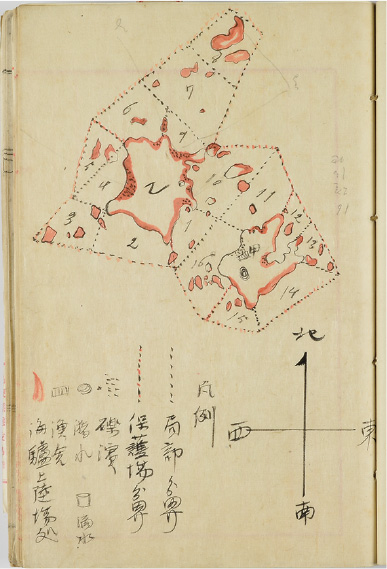
in 1904 (Meiji 37)
[Repository] Shimane Prefecture Public Records Center
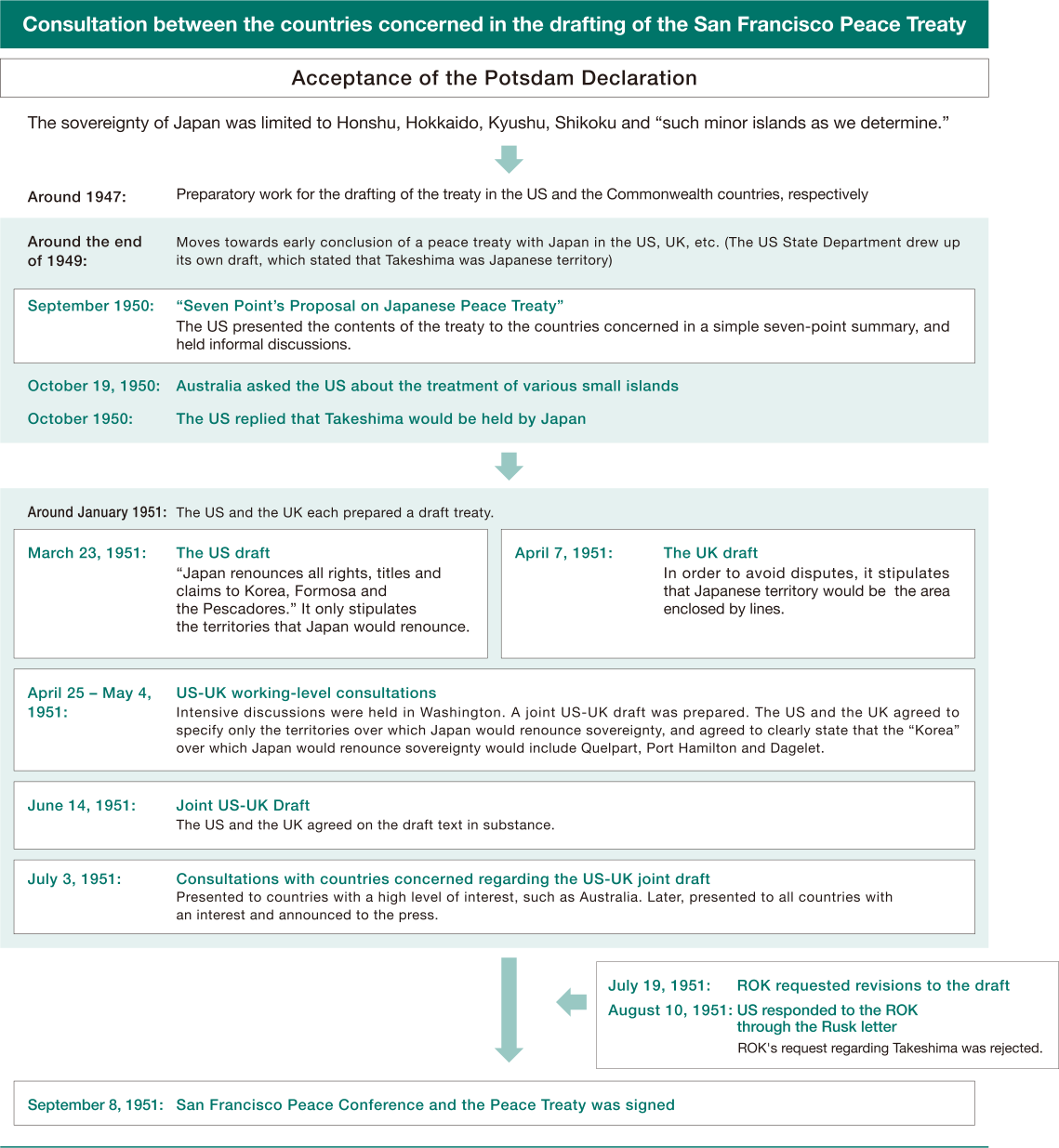
Japan continues to have sovereignty over Takeshima under the San Francisco Peace Treaty but it has been illegally occupied by the Republic of Korea (ROK).
Japan's territory after WWII was legally defined under the San Francisco Peace Treaty. In May 1951, the
United States and the United Kingdom, which led the drafting of the treaty, agreed that the islands of
Quelpart, Port Hamilton and Dagelet should be included as part of “Korea,” which was to be renounced by
Japan, in order to clearly define the boundary between the territories of Japan and Korea in the draft.
Takeshima was not included as part of "Korea."
Upon learning of the text drafted by the United States and the United Kingdom, in July 1951, the ROK
requested to add Takeshima as part of "Korea," which Japan would renounce. However, the US rejected the
ROK’s request, stating the island had been "never treated as part of Korea." As shown by the drafting
history above, it is obvous that Japan continues to have sovereignty over Takeshima under the San
Francisco Peace Treaty as it had before WWII.
In January 1952, shortly before the San Francisco Peace Treaty entered into force, the ROK issued a
declaration concerning maritime sovereignty, with which it unilaterally established the “Syngman Rhee
Line,” encompassing Takeshima in contravention of international law. Despite protests from the
international community, the ROK did not withdraw the declaration. From 1953 to 1954, the ROK illegally
occupied Takeshima using physical force, including firing on Japan’s patrol vessels.
Agreement in the US-UK consultations
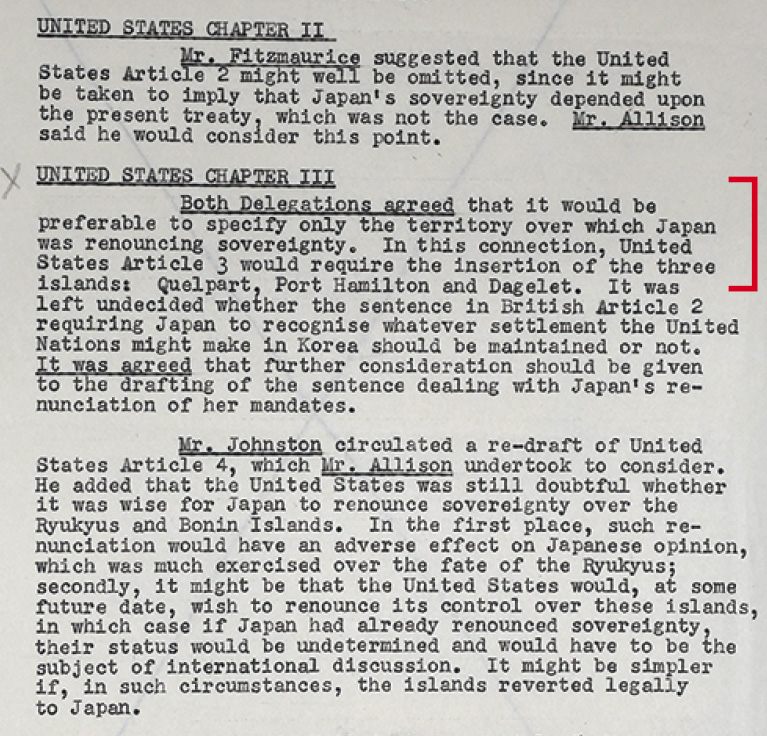
The US and UK had intensive consultations in Washington, DC, from April 25 to May 4, 1951. At the 7th meeting of the consultations, both delegations agreed that it would be preferable “to specify only the territory over which Japan was renouncing sovereignty,” and confirmed that “the insertion of the three islands: Quelpart, Port Hamilton and Dagelet” was required for the provision on the renunciation of Korea in the US draft.
Anglo-American Meetings on Japanese Peace Treaty (Excerpt)
Both delegations agreed that it would be preferable to specify only the territory over which Japan was renouncing sovereignty. In this connection, United States Article 3 would require the insertion of the three islands: Quelpart, Port Hamilton and Dagelet.
The Japanese have been using Takeshima since the Edo period under the permission of the Edo Shogunate! In 1905, Takeshima was incorporated into Shimane Prefecture, and activities such as sea lion hunting were conducted under government control! In light of these circumstances, It is obvious that Japan continues to have sovereignty over Takeshima under the San Francisco Peace Treaty! However, it was illegally occupied by the ROK in the 1950s, and the illegal occupation continues until the present day.
For those who want to know more
Takeshima in the 17th century
17th century: The Oya and Murakawa Families' Passage to Utsuryo Island and Takeshima
In 1617, the Oya family, merchants from Yonago who ran a shipping business, drifted ashore on Utsuryo
Island (Ulleungdo in Korean).
They discovered that the island was uninhabited and rich in timber and marine products. They invited the
Murakawa family to join them and requested and received permission from the Edo Shogunate to travel to
Utsuryo Island. The two families took turns traveling to Utsuryo IsIand every year to conduct business.
Takeshima, located on the route from Oki to Utsuryo Island, was used as a navigation marker and as a
place to moor their ships. With the permission of the Shogunate, it was also used as a good place to
catch sea lions and abalone.
In 1692 and 1693, the Oya and Murakawa families encountered Korean fishermen on Utsuryo Island, and
negotiations on the island were held between Japan and Korea. The Shogunate prohibited the families to
travel to Utsuryo Island, but passage to Takeshima was not prohibited.
Passage to Takeshima and Utsuryo Island
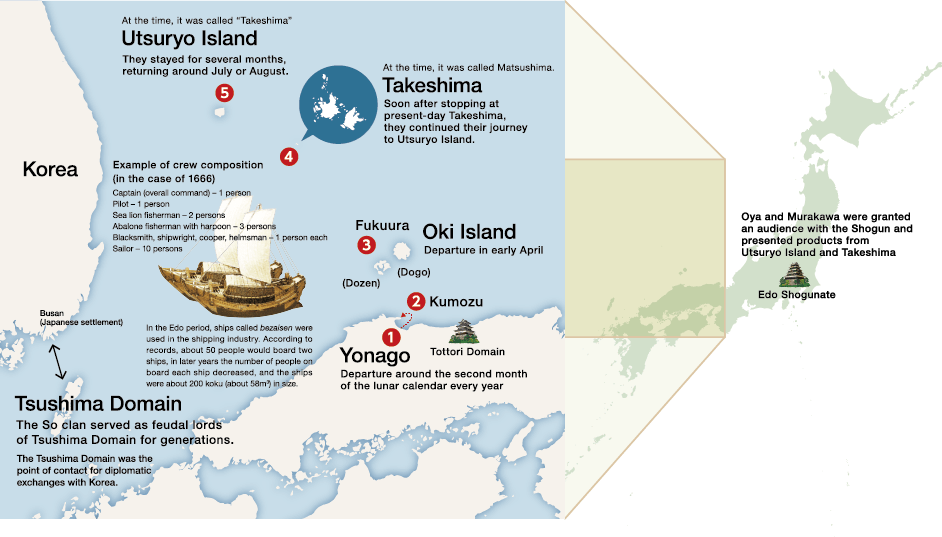
❶ The ships would depart Yonago around the second lunar month each year.
❷ They would stop at Kumozu and take on more passengers.
❸ After leaving the mainland, the boats would first stop at Oki to prepare for the crossing. More passengers would join them here.
❹ They would use Takeshima as a navigational marker and a place to moor, and would catch sea lions and abalone. From 1661, it was decided that the Oya and Murakawa families would take turns travelling to Utsuryo Island each year and carry out their business.
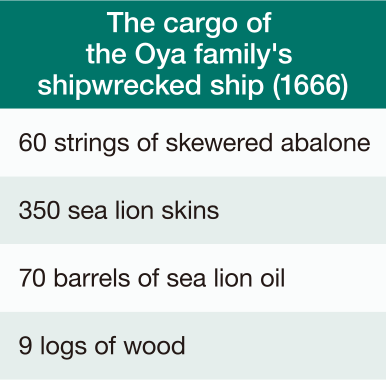
❺ They stayed on Utsuryo Island for several months. They went to Utsuryo Island with two ships, built a third ship there to load their cargo, and returned with three ships, but during the passage in 1666, two ships brought from the mainland were shipwrecked, and only the newly built ship remained.
Passage with permission from the Edo Shogunate
The Oya and Murakawa families' passage to Utsuryo was made possible by the work of a Hatamoto (a high-ranking samurai in the direct service of the Shogun) named Abe Shiro-Goro*, who approached the Roju (Council of Elders) and obtained permission from the Roju in a joint letter to the lord of the Tottori domain. From then on, Abe Shiro-Goro acted as intermediary for the Oya and Murakawa families and arranged audiences with the Shogun and the presentation of products to high-ranking samurais in the Shogunate.
*First names of the heads of the Abe were “Shirogoro” for generations.
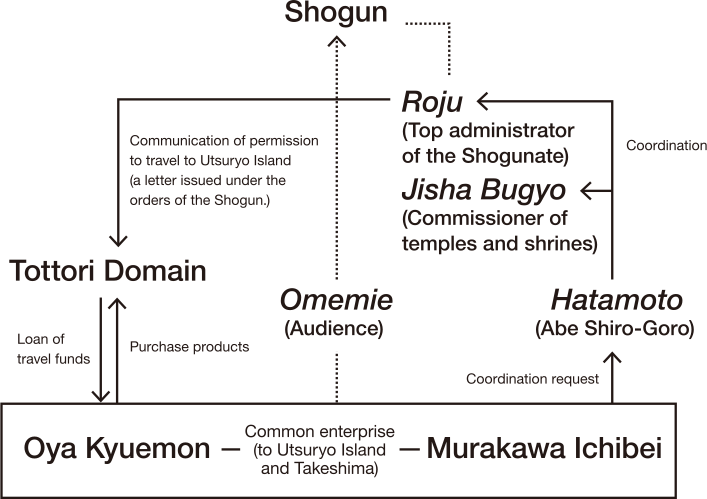
The cargo of the Oya and Murakawa family's shipwrecked ship

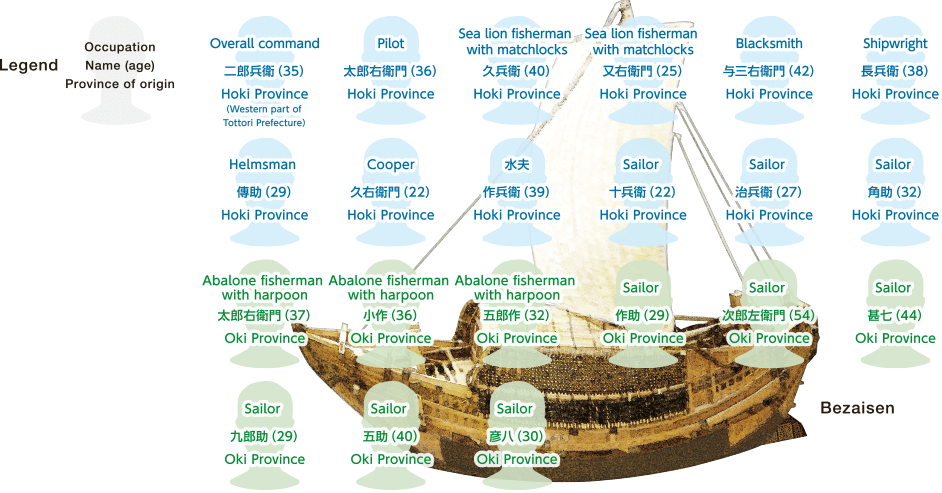
Composition of the Crew of the Shipwrecked Oya Family Ship (1966)
During the passage of the Oya and Murakawa families to Utsuryo Island, there were cases in which people were rescued from shipwrecks in Korea and handed over to the Japanese side. Looking at the relevant records, we can see details of both families' journeys.
Japanese people caught sea lions and abalone on Utsuryo Island and Takeshima in the 17th century!
They had permission from the Edo Shogunate to do so!
Considering the friendly relations between Japan and Korea, the Edo Shogunate prohibited the Oya and
Murakawa families from traveling to Utsuryo Island at the end of the 17th century. But travel to
Takeshima was not banned.

Takeshima before WWII
Before WWII: The Incorporation of Takeshima into Shimane Prefecture and Peaceful and Continuous Exercise of Sovereignty.
Around 1900, sea lion hunting became active around Takeshima. Nakai Yozaburo, a resident of the Oki
Islands in Shimane Prefecture who had engaged in sea lion hunting since 1903, became concerned about
excessive competition and submitted a request in September 1904 to three government ministers (the
Minister of Home Affairs, the Minister of Foreign Affairs, and the Minister of Agriculture and Commerce)
for leasing Takeshima, which was called the "Lyanko Islands" at the time.
Upon the request from Nakai, the Japanese Government incorporated Takeshima into Shimane Prefecture by a
Cabinet decision. Based on this decision, on February 22 the same year, the Governor of Shimane
Prefecture issued an official notice to name the island “Takeshima*” and put it under the jurisdiction
of the Director of Oki Islands Branch Office. These announcements were also published in newspapers of
the time and widely disseminated to the general public.
After that, the Japanese Government openly exercised administrative rights over Takeshima for the
purpose of managing sea lion hunting, etc. For example, in 1905, the Governor of Shimane Prefecture
registered Takeshima in the State Land Register and designated the sea lion hunting as a fishery
activity that required a license. Shimane Prefecture also allowed sea lion hunting by having Nakai and
three other experienced people form a joint company, and in 1921, it granted these sea lion hunters
permission to collect seaweed and shellfish on Takeshima.
Sea lion hunting by the people of Oki continued until 1941.
*Since the early Meiji period, Takeshima was called "Lyanco Island" in Japan after its western name of “Liancourt Rocks”
September 29, 1904
Nakai Yozaburo, who lived on Oki Island, submitted a request to the Government to lease Takeshima.
Nakai Yozaburo
Born in Ogamo Village, Tohaku County, Tottori Prefecture, in 1864 (Genji 1). He lived in various places including Kyushu, San'in and Hokuriku, traveled to Russia (Vladivostok), Korea and other places, and was involved in the development of marine product businesses such as sea cucumber and abalone fishing business. He also received a commission from the Oki Fisheries Cooperative Association to conduct experimental fishing.
1903 (Meiji 36) Tried sea lion hunting on Takeshima for the first time.
1904 (Meiji 37) Submitted a request to the Japanese Government to lease Takeshima.
1905 (Meiji 38) Received permission to hunt sea lions on Takeshima.
1929 (Showa 4) Became the mayor of Saigo Town (until 1932 (Showa 7)).
1934 (Showa 9) Passed away (age 70).
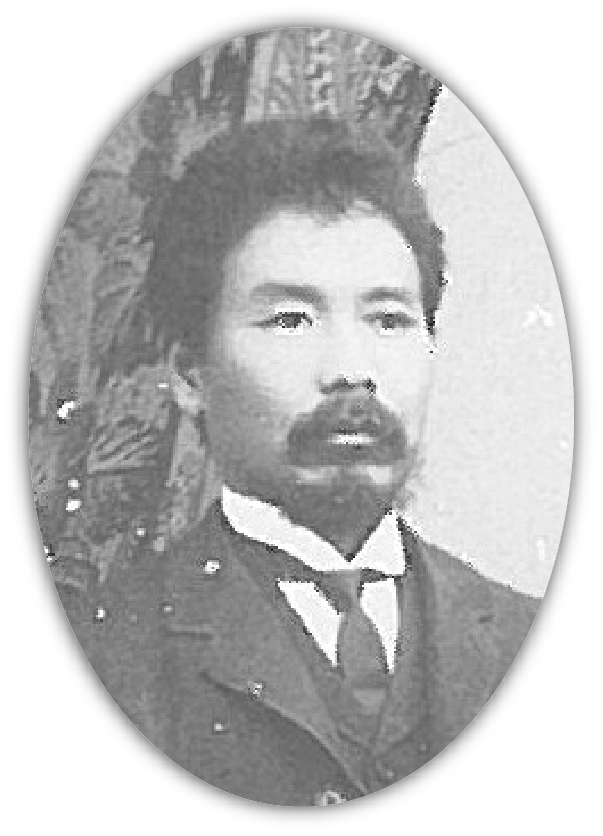
January 28, 1905
Cabinet decision to incorporate Takeshima into Shimane Prefecture
February 22, 1905
The Governor of Shimane Prefecture issued a public notice regarding the location, affiliation, name and jurisdiction of Takeshima.
Examples of the exercise of administrative authority over Takeshima (after the incorporation of Shimane Prefecture)
March 29, 1909
Takeshima was included in the jurisdiction area of the Oki Islands by an Imperial Edict
In 1909 (Meiji 42), an Imperial Edict was issued to designate the Oki Islands as one of the islands to establish the Island Branch Office and to designate Takeshima, along with the Oki Islands, as part of the jurisdiction of the Oki Island Branch Office.
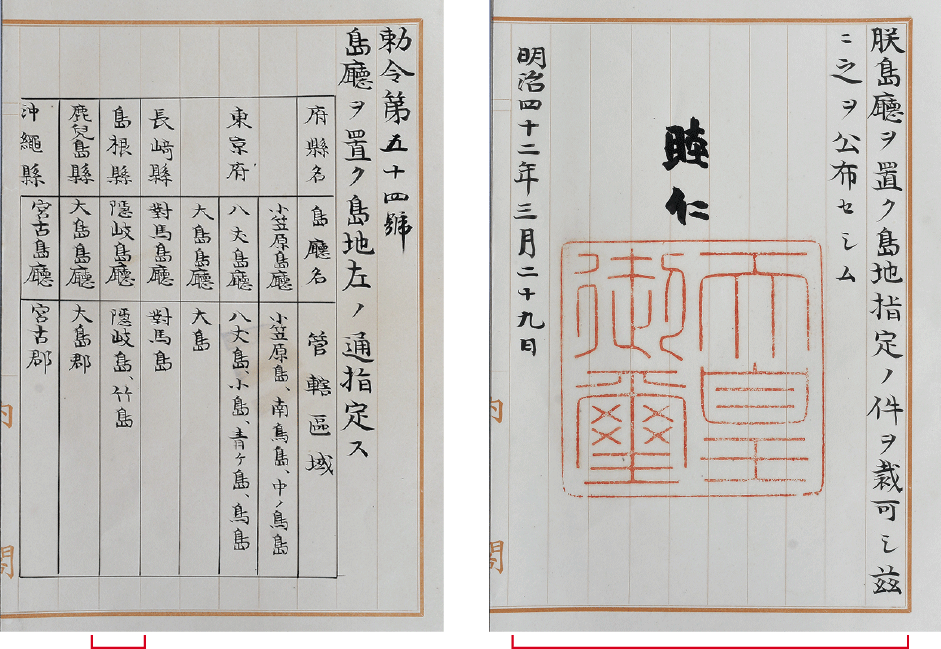
Repository: National Archives of Japan
June 5, 1905
Issue of a permit for sea lion hunting
Shimane Prefecture granted a permit to Yozaburo Nakai and others to engage in sea lion hunting on Takeshima. One permit was issued. After that, permits were issued every five years.
April 1, 1921
Permission granted to collect nori and wakame seaweed around Takeshima
Shimane Prefecture revised the Shimane Prefecture Fishery Control Regulations at the time, and decided to allow sea lion fishermen to collect seaweed and shellfish in a specified area around Takeshima.
So, the incorporation of Takeshima into Shimane Prefecture was triggered by the increase in sea lion hunting! The Japanese Government took various measures to manage Takeshima, but there was no opposition from any country!
Takeshima after WWII
After WWII: The San Francisco Peace Treaty and the Illegal Occupation of Takeshima by the Republic of Korea
The San Francisco Peace Treaty, which ended the state of war after World War II, stipulated that Japan “renounces all right, title and claim to Korea, including the islands of Quelpart, Port Hamilton and Dagelet.” A closer look at the drafting of this provision shows that Takeshima was deliberately excluded from the text. Although the Republic of Korea (ROK) was aware that Takeshima was not included in the “Korea” that Japan renounced in the Peace Treaty, in January 1952, shortly before the San Francisco Peace Treaty entered into force, the ROK issued a declaration concerning maritime sovereignty, with which it unilaterally established the “Syngman Rhee Line,” encompassing Takeshima in contravention of international law. Despite protests from the international community, the ROK did not withdraw the declaration. From 1953 to 1954, the ROK illegally occupied Takeshima by physical force, including firing on Japan’s patrol vessels.
January 18, 1952:
The ROK President issued a declaration concerning maritime sovereignty
The issue became more serious as a number of incidents occur in which Japanese fishing boats were seized for allegedly violating the so-called “Syngman Rhee Line,” mainly in the waters from around Jeju (Quelpart) Island to Tsushima.
April 28, 1952:
The San Francisco Peace Treaty entered into force
Takeshima was provided to the US Forces as a bombing range. In March 1953, the designation of the island as a bombing range was lifted in response to requests from Shimane Prefecture. Travel to Takeshima was resumed. Meanwhile, as illegal landings by ROK nationals were being confirmed, the Japanese authorities began taking enforcement measures.
July 12, 1953:
The Hekura gunfire incident involving a Japan Maritime Safety Agency patrol boat
The Japan Maritime Safety Agency patrol boat “Hekura” was fired at dozens of times near Takeshima.
June 1954:
ROK deployed a maritime police unit to illegally occupy Takeshima
Although it is obivious that Takeshima continues to be Japanese territory under the San Francisco Peace Treaty, the ROK illegally occupied it using physical force.
Takeshima in Antiquated maps in Japan and Korea
A comparison between Japan and Korea regarding the presence or absence of detailed maps of Takeshima on old maps
The map on the lower right (Figure 1) is the first map of Takeshima (based on modern surveying methods)
produced by the ROK government (Hydrographic Division under the Operations Department of the ROK Navy)
in 1954. In Japan, detailed maps of Takeshima (maps showing the two main islands) were made in the Edo
period (17th century) based on the practical knowledge of the Japanese people (Figs. 2-1, 2-2, 2-3). In
addition, a survey map of Takeshima was made in 1908 using modern surveying methods in Japan (Fig.
3).
To date, no detailed maps of Takeshima made during the Joseon Dynasty, including the Korean Empire
period, have been confirmed.
This difference in the timing of the production of detailed maps of Takeshima in Japan and Korea shows
that Korea, unlike Japan, had no real use for Takeshima in the pre-modern period.
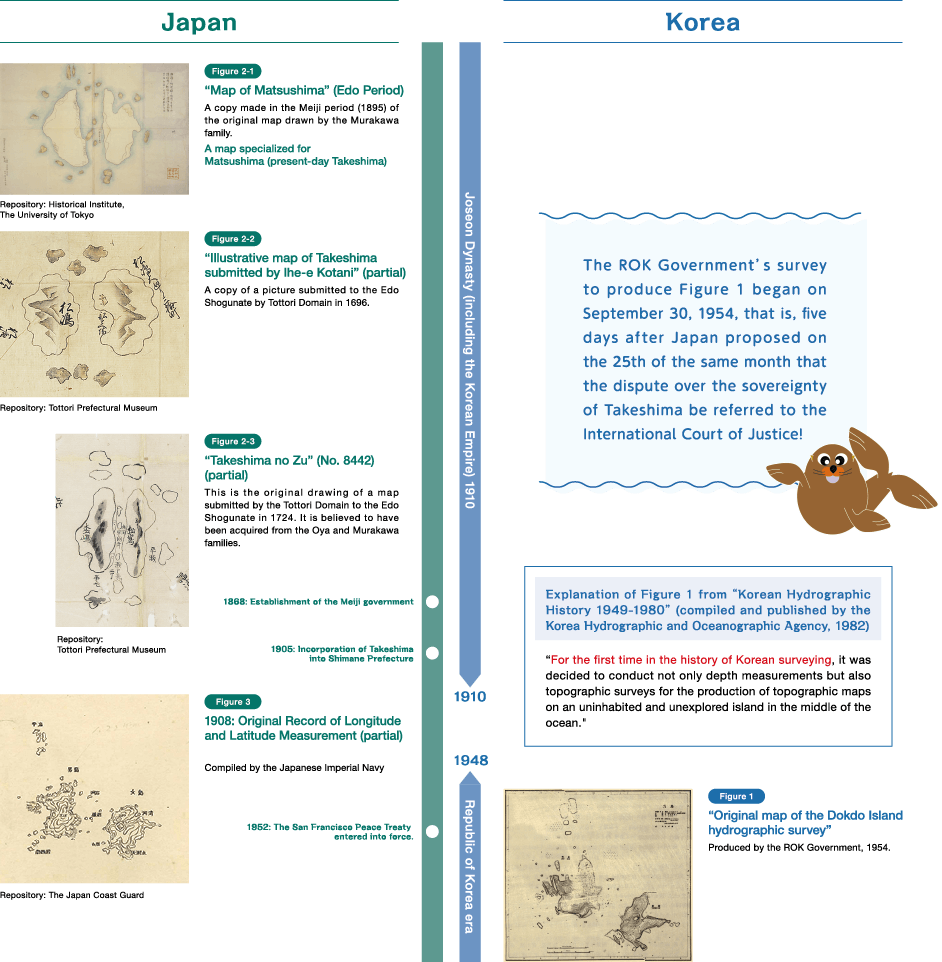
In Japan, maps depicting the two large islands of Takeshima were made as early as the Edo period. On the other hand, it has not been confirmed that maps depicting the two large islands of Takeshima were made in the Joseon Dynasty, which lasted until the beginning of the 20th century. You can see the difference in the knowledge that Japan and Joseon had about Takeshima!
Exhibit
A letter from Kameyama Shozaemon to Oya Kyuemon Katsuzane (Excerpt)
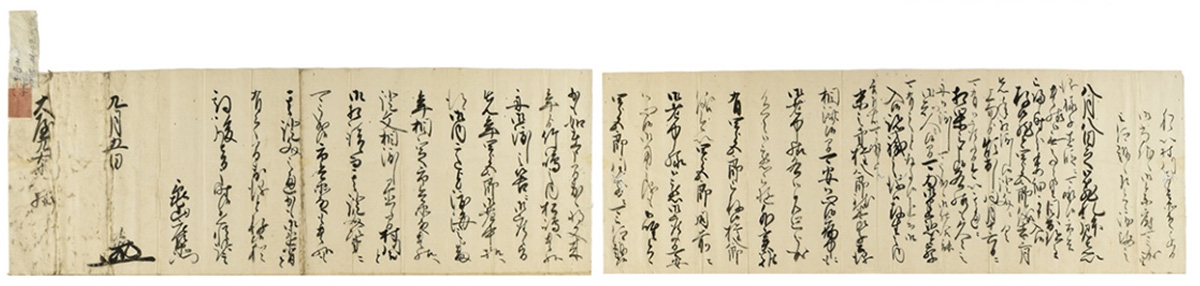
(Provisional translation)
… Also, as regards the crossing of the sea of your ship to Matsushima near Takeshima, starting from
next year, Shirogoro* obtained permission from the Council of Elders earlier.The yearly rotation for
crossing the sea has been set, and I have given award to Ichibe and you, so please follow the
instructions in the award after consulting with Murakawa (Ichibe).
I believe that neither Ichibe nor you will go against the award in the slightest.Until we meet again.
With the utmost respect Kameyama Shozaemon September 5th (signature) Oya Kuemon
*This refers to a Hatamoto (a high-ranking samurai in the direct service of the Shogun) named Abe Shirogoro. Kameyama Shozaemon was one of the retainers of Abe Shirogoro. The heads of the Abe family were named Shirogoro from generation to generation. The Oya and Murakawa families' passages to Utsuryo Island(It was called“Takeshima”at the time)were made possible by Abe Shirogoro approaching the Roju (Council of Elders) and obtaining permission from the Shogunate in a joint letter from Roju addressed to the lord of the Tottori domain. Subsequent generations of Abe Shirogoro continued to act as intermediary for the Oya and Murakawa families in arranging audiences with the Shogun and in sending gifts to high-ranking samurais in the Shogunate.
